Oxford University Crest

The Armstrong Research Group
Inorganic Chemistry Laboratory

Third floor ICL, rooms: T7–T12, T17
Phone: T12 (Fraser’s office): +44 (0)1865 272647
e-mail: fraser.armstrong@chem.ox.ac.uk


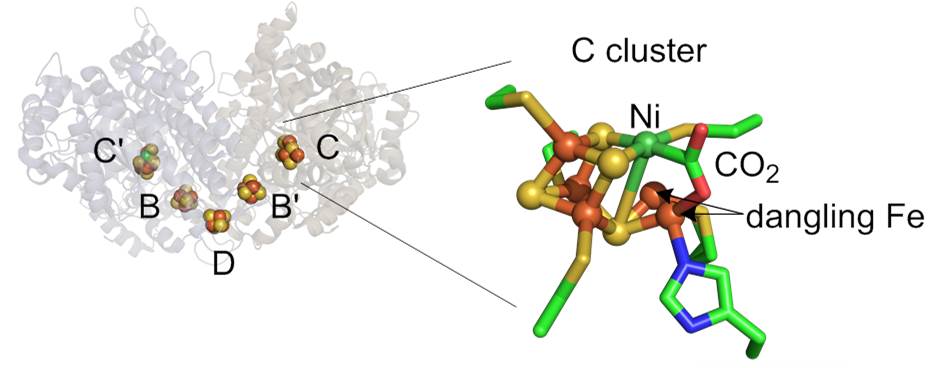
We use physical (advanced electrochemical and spectroscopic techniques) and molecular biological methods to exploit the important and exquisite reactivities of redox-active metal sites (Fe, Ni, Cu, Mo) and catalytic centres in proteins. A major focus is on energy in all its biologically-relevant aspects, ranging from future energy technologies to energy processing by living cells. The range of enzymes that we study includes those that carry out catalytic electron transport in energy-producing electron transport chains (which have important medical relevance), enzymes called 'blue Cu' oxidases that catalyse the highly efficient conversion of O2 into water, and enzymes called hydrogenases that catalyse the production and oxidation of hydrogen. 'Blue Cu' oxidases and hydrogenases have obvious and important relevance for future energy technologies such as fuel cells. Hydrogenases in certain organisms such as green algae and cyanobacteria may one day be responsible for producing H2 from sunlight; in addition the active sites of these enzymes, containing Fe and Ni, are inspiring new directions in catalysis.

A major development in our group is the suite of techniques known as Protein Film Electrochemistry (PFE). Here, protein molecules immobilised on an electrode surface are "interrogated" by dynamic electrochemical techniques: both the reactions of discrete redox centres in enzymes and catalysis can be studied. Electron-transfer processes in these complex macromolecules are probed by PFE, which provides a powerful way to observe and control active sites, complementing the more familiar spectroscopic techniques.

Our electrochemical studies link up with two other interests; first, surface chemistry in which we are developing methods for covalently attaching enzymes to carbon electrodes; second, development of novel technologies that use enzymes as catalysts. Other techniques include rapid solution kinetics (diode-array stopped-flow), EPR spectroscopy, and many of our experiments are carried out under anaerobic conditions using glove boxes. We have extensive collaborations with spectroscopists and molecular biologists worldwide.

A number of Part II positions are available each year and applications are welcomed for DPhil positions.
The Armstrong Group, 2011